
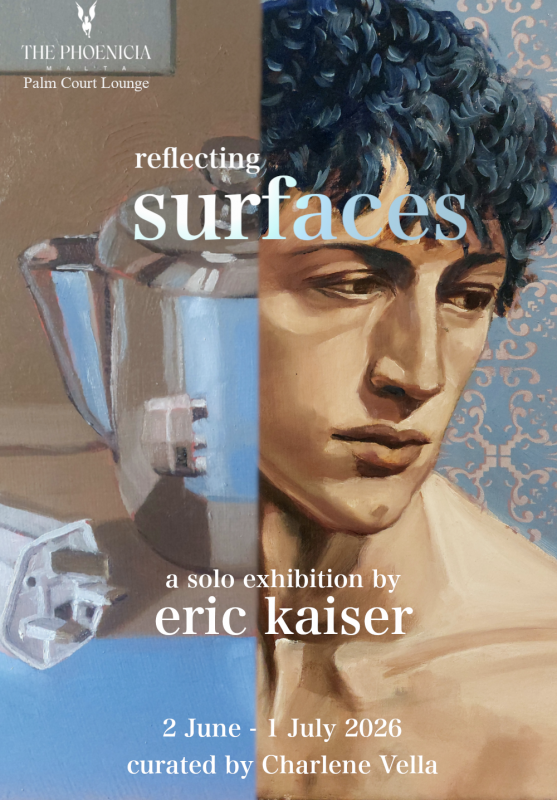

Sous le titre Reflecting surfaces / Surfaces réfléchissantes, l’exposition d’Eric Kaiser met en tension deux régimes de présence : celui des figures, absorbées dans une forme de retrait mental, et celui des objets, notamment les pichets argentés, dont la surface active le regard par le jeu du reflet. La peinture ne distingue plus nettement le sujet de l’objet ; elle organise au contraire une circulation entre intériorité et matérialité, entre ce qui pense et ce qui renvoie.
Les portraits, aux carnations volontairement non naturelles et aux fonds décoratifs inspirés des carrelages maltais, apparaissent comme des présences à la fois singulières et distantes, presque objectales. À l’inverse, les natures mortes se chargent d’une vitalité silencieuse : les pichets captent la lumière, absorbent l’espace et semblent contenir une scène invisible. Dans cet ensemble, la surface n’est jamais neutre. Elle réfléchit, au double sens du terme : elle reflète le monde tout en invitant à le penser.
Under the title Reflecting surfaces, Eric Kaiser’s exhibition brings two modes of presence into dialogue: figures absorbed in a form of mental withdrawal, and still lifes, especially the silver pitchers, whose reflective surfaces activate the gaze. Painting here no longer clearly separates subject from object; instead, it creates a circulation between interiority and materiality, between what thinks and what reflects.
The portraits, with their deliberately non-naturalistic flesh tones and Maltese tile-inspired backdrops, appear at once singular and distant, almost object-like. By contrast, the still lifes acquire a quiet vitality: the pitchers catch the light, absorb the surrounding space, and seem to hold an unseen scene within them. In this exhibition, the surface is never neutral. It reflects, in both senses of the word: it mirrors the world while also inviting us to think it.
Review from Pr. Charlene Vella for Malta today on the 16th of June 2026
French artist Eric Kaiser presents Reflecting Surfaces, a new body of work that explores
the shifting relationship between portraiture and still life through a series of psychologically
charged paintings infused with colour, humour, and subtle theatricality.
Developed during the final months of the artist’s stay in Malta before his departure in
September, the exhibition can be understood as both a meditation and a farewell. Over the
past four years, Malta has become a key site of transformation in Kaiser’s artistic practice,
and this exhibition brings together many of the visual and conceptual concerns that have
emerged during this period.
At first glance, the works appear divided into two distinct groups: portraits of predominantly
male figures and still lifes centred on polished silver jugs and domestic objects. Yet the
exhibition gradually reveals that these subjects operate within the same emotional and
pictorial register. Kaiser deliberately dissolves the traditional boundaries between the
human figure and the object world. His portraits possess an object-like stillness, while the
still lifes seem animated by an almost psychological presence.
The title itself contains a subtle play on words, with “surfaces” quietly evoking “faces”,
reinforcing the exhibition’s continuous dialogue between human presence and reflective
objects. Faces become surfaces to be read, while reflective vessels begin to assume
psychological and emotional qualities traditionally associated with portraiture.
The figures themselves are marked by introspection. Their expressions are restrained and
often detached, rendered in highly unnatural colour palettes of electric blues, cool greys,
olive greens, and warm ochres. These chromatic decisions are not decorative, but deeply
structural. Colour becomes a vehicle for atmosphere and emotional ambiguity rather than
realism. Faces appear withdrawn into states of contemplation, silence, or suspension.
Yet alongside this seriousness lies an unmistakable playfulness. Patterned backgrounds
echo geometric textiles, wallpapers, or stage sets, introducing rhythm and visual wit into
the portraits. Likewise, the still lifes incorporate intentionally mundane and contemporary
objects: electrical plugs, toys, fruit, cloths, and kitchen utensils coexist with reflective metal
vessels traditionally associated with academic still-life painting. A toy figurine sprawled
beside a silver jug or the absurdly tactile presence of a plastic plug introduces moments of
irony and tenderness into compositions that might otherwise risk austerity.
This dialogue with the history of still life is central to the exhibition. Historically considered
a “lesser” genre within academic hierarchies, still life painting was long regarded as inferior
to portraiture or grand historical subjects. Yet over centuries, it evolved into one of the
most sophisticated arenas for artistic experimentation and observation. Today, still life
remains the foundation of academic artistic training: the place where artists learn to see
light, volume, texture, and spatial relationships. Kaiser embraces this lineage whilst
simultaneously unsettling it. His reflective jugs distort their surroundings, fragment colour
and form, and suggest unseen spaces beyond the canvas. The objects do not merely sit
before us; they seem to watch, absorb, and remember.
Particularly significant within the exhibition is Kaiser’s self-portrait, the only major portrait
detached from the patterned backgrounds that dominate the other figurative works.
Positioned almost as a quiet culmination of the series, the painting possesses a striking
clarity and vulnerability. Surrounded by a luminous circular form reminiscent of both halo
and spotlight, the artist confronts the viewer directly. It functions not only as a self-image,
but as a reflection on presence, departure, and artistic identity at the close of an important
chapter.
In Reflecting Surfaces, nothing remains entirely fixed. Surfaces mirror and distort
simultaneously. Objects acquire emotional weight, while figures become strangely
sculptural and distant. Kaiser invites viewers into a world where looking itself becomes
unstable, poetic, and deeply reflective.
The exhibition is open throughout June 2026 in the Palm Court Lounge at The Phoenicia